
Repositories and Data Access Objects are still alive

In my previous articles when I was talking about Clean architecture and Domain Driven Design I mentioned one piece of domain layer – repository or more precisely repository pattern. The repository pattern is used to persist and retrieve domain models. Although repositories are mostly related to Domain Driven Design the other architectures might have the objects with the same functionality but are called different. In Fitradar application (front end and back end) the objects that are used to persist data in the database and fetch data from the database and map data to in-memory objects (aka POCO – Plain Old C# Object, POJO – Plain Old Java Object) and are not part of the Domain layer are called DAO (Data Access Objects). DAO usually are used in cases when no business logic is involved and the application needs to execute simple CRUD operation.

In Android application to work with database we use Room Persistence library but in our back-end solution we use Entity Framework Core. These two are know as Object-relational mappers or ORM. And today I wanted to explore the relationship between Domain Repositories, Data Access Objects and ORM and share some experience we had in our team working with these patterns and libraries.

If you look at the responsibilities of Repository, DAO and ORM they are very close to each other. Some years ago when ORM technology was in its inception the DAO and Repositories usually were working directly with the low level database access services. In case of .NET it was ADO.NET library and in case of Android it was SQLite library. And it was quite clear that DAO or Repository should use these libraries to persist or retrieve in-memory objects and map the data. But now-days when in application development main data access technology became ORM the border between ORM and DAO and Repository has become very blur, especially when one just switched to ORM. Working with ORM in different projects and languages our team came to conclusion that in same cases ORM can fully replace the DAO or Repository and can be used instead of it. Let’s look closer at the cases when it is appropriate to use just a ORM library and when the DAO or Repository should be used in combination with ORM:

  • If you need to save, update or delete single flat plain old object then in most cases ORM library will do the job for you. Of course EF Core and Room are capable of doing more, but then we really should investigate each case separately
  • If you need to fetch the data from single table by primary key then again in most cases you can fully relay on ORM
  • In case Domain layer aggregate has complex entity cluster hierarchy, where different entities might have different persistence state you most likely will need to write such aggregate persistence logic by yourself either using ORM or low level database access library. In our application one such aggregate is Sport Event that has Place and Organizer and some other entities. And the problem we faced when tried to save Sport Event by using built in EF Core capabilities was the different Entity State and the calculated state before Save operation. For example we had cases when we needed to create a Sport Event in Place that was not yet saved in database, and since both entities have the same Entity State EF Core tackled that case well and was able to create both entity records in database. But the problem started to appear when we wanted to create Sport Event in the Place that already had other Sport Events, now before saving aggregate Sport Event we had to fetch Place entity to make sure EF Core sets the correct Entity State. And the more entities your aggregate root has the more fetch operations might be needed. So in this case for us seemed obvious putting Entity State synchronization logic in separate Repository.
  • In case data query logic and following mapping logic is so complex that to make a code readable it is necessary to split logic in separate functions, you most likely will move those functions to separate class, Data Access Object, to persist the Single Responsibility principle.

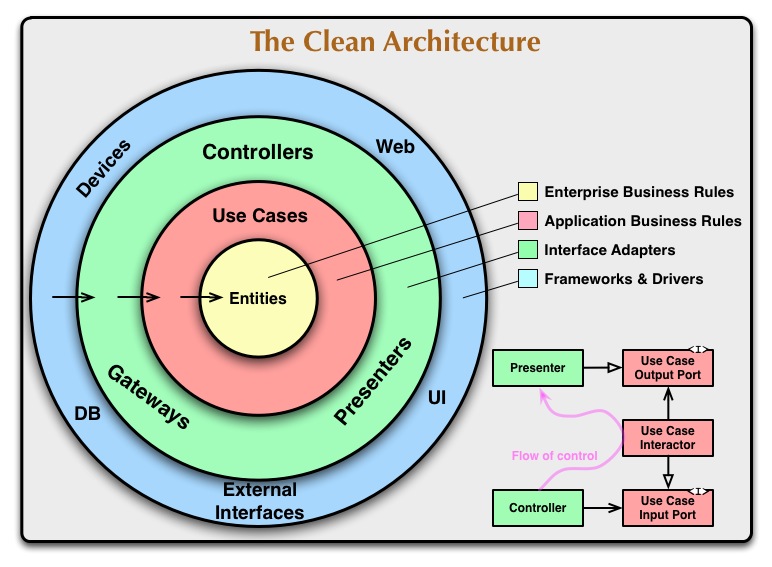
As you can see the Repository and DAO still has their place in the modern software architecture. In case of queries in CQSR architecture query logic might be put in Application layer since anyway contrary to Commands, Queries only responsibility is data fetching, and that duplicates DAO responsibility. By choosing to put query logic in Application layer we make a direct dependency on EF Core. That is not a problem in classical three layer application, but it does not fit the Clean Architecture principle where Application layer should be aware only of Domain layer and with outer layers (EF Core belongs to the Infrastructure layer) communicates only through interfaces. In this case we should use DAO.

Please visit our website and join the mailing list. Our app is coming soon:
http://fitradar.me/

Clean architecture for our back-end

Today I want to continue discussing the architecture we came up with for our back-end service. In the previous article I brought up some arguments why it was important for us to separate read and write models. And the main thing that made it clear was that we operated with two different data sets for read and write operations. But I didn’t go much in to the details on how we arrived at such a different models. And this aspect of CQRS will be the topic of today’s article. Before we even realized we need to apply CQRS pattern in our design we decided to follow Uncle Bob’s Clean Architecture the same architecture we used in our mobile application development.

And the the reasoning that brought us to this architecture I lied down in one of my previous articles. Although on both platforms the overall architecture was the same but implementation details were quite different. The main attraction point of this architecture was possibility to build the server side application around the Domain Model and apply Domain Driven Development. There are several definitions for Domain Model and some of them you can find here but for us in the design process more important was to understand the peaces that constitute the Domain model. It allowed us in the next designing steps to decide whether we need a separate Domain model layer or entities were just enough. Quite often I notice that the architecture does not make a big difference between the bare bones domain entities and full domain model. In first case entities are just a database relational model, and they serve as in memory tables. In many cases especially in ASP.NET world (the framework we are using to build our back-end services) Object Relational Mappers like Entity Framework require to separate entities from the CRUD operations and thus giving impression that full-fledged Domain model is created, but in fact you end up with something what is called Anemic Domain model which is considered an anti-pattern. So following the advise of Eric J. Evans in his book Domain-Driven Design: Tackling Complexity in the Hart of Software we noted for ourselves following parts that should be presented in our Domain Model in order to consider it us a separate layer:

  • Entities accompanied with business methods
  • Value objects
  • Repositories
  • Aggregates
  • Bounded Context

By analyzing our model designed for Android or iOS platform and for our back-end platform we realized that only our back-end model meets Domain Model criteria and deserves a separate layer but in case of mobile phone platforms we ended up with simple entities that were the part of application or Use Cases layer.

By modeling entities we replicate real life entity attributes, like person’s name, surname or gender that are operated by methods encapsulated in the same entity or in service. At the end of the modeling process we come up with our business model that further can be converted to the Entity-Relationship model, that is used to build the database. In such way Domain model or plain entities are tightly bound to normalized ER model. And one can live only with one ER model until the moment when displayed information starts more and more deviate from the ER model and in order to fetch the data from database more complex queries are required. And this is the time when we started to consider CQRS. But now it was not clear how to integrate the CQRS in Clean Architecture layers and we turn to the mighty Google for someone’s else experience and we found this wonderful talk that showed us exactly what we were looking for and so we ended up by extending the application layer with commands and queries and adding separate Database context or our queries.

Please visit our website and join the mailing list. Our app is coming soon:

http://fitradar.me/

Study: fitness boosts brainpower in adults

Physical fitness has been associated with better brain structure and brain functioning in adults.

The findings of a study, led by Dr Jonathan Repple of the University Hospital Muenster in Germany, suggests that increasing fitness levels through exercise could result in improved cognitive ability – such as memory and problem solving – as well as improved structural changes in the brain.

A group of researchers led by Repple used a publicly available database of 1,200 MRI brain scans from the Human Connectome Project and combined it with physical testing to assess the subjects’ physical fitness. Each one’s cognitive ability was also measured. The researchers excluded subjects with pre-existing conditions, such as neurodevelopmental disorders, diabetes or high blood pressure.

The results of the study showed that physical endurance was positively associated with the global cognition scores of the subjects taking part.

In its conclusion, the group of researchers said the results of the study suggest that physical exercise could be used as a form of preventative healthcare.

“The observed pattern of results appears to support the notion of a beneficial effect of physical fitness on cognitive function,” the study reads.

“This notion is supported by the few available experimental studies indicating that physical exercise leads to increases in memory performance and brain structural integrity.

“This concept might be of relevance for a wide range of domains in health and life sciences including prevention, clinical care and neurobiological research.

“Along with previous findings, our findings point to the potential of physical fitness as a modifiable factor that might be applied as an intervention in prevention and clinical care.”

The report was simultaneously published in the Scientific Reports journal and presented at the ECNP Congress in Copenhagen, Denmark.

To read the study in full, click here.

Source: http://bit.ly/30Pqjy3

Please visit our website and join the mailing list. Our app is coming soon:

http://fitradar.me/